Tuesday, May 19, 2020

Who'da Thunk It?

We sort of knew what we'd be getting into when we bought this farm from Neta's family, but there are days where we just look at each other with bewildered looks and realize that "we never saw that one coming".

Sure, we knew that we'd spend lots of time cutting grass, creating gardens (both vegetable and flower), clearing trees and brush, fixing up various structures, building new ones and eventually getting some animals for various purposes, like chickens. What we didn't envision...becoming veterinary surgeons. We did not have doing surgery on chicken feet on our "Farm Chores Bingo Card".

One of our chickens (Annie, as in "Little Orphan" since she's mostly reddish-brown) has been limping around a bit and walking completely flat-footed. A quick check of the internet gave us a list of possible ailments and looking at Annie's feet revealed the most obvious culprit...Bumblefoot.

Chicken with Bumblefoot
Hard, swollen pad with a black scab. Drs. Craig & Neta to the OR...STAT! 

Bumblefoot is basically a staph infection usually in the pad of the foot, but can also show up in other parts of the foot. A hard, infection-filled abscess forms in more advanced stages. It can be caused by a variety of things, but it usually starts with a scrape or cut on the chicken's foot. And considering that they scratch around in dirt and their own poop all day, it's an environment ripe for infection.

Neta and I agreed that she would hold Annie, while I did the surgery. Then I would hold Annie while she dressed the wound.

Step one was putting the Annie's feet into a bath of warm water and Epsom salts for 10 minutes. We had an old cooler that worked out well as the recommendation was to keep the chicken is a darkened place to help her stay calm. Don't worry, we kept the lid barely cracked so she wouldn't suffocate.

Just prior to closing the lid for about 10 minutes.


After the bath we dried her feet, put her headfirst and upside down into a cloth bag (again to keep her calm) and moved on to step two: Removing the abscess.

This is where things get interesting, for us anyway. We did not have the benefit of a sanitized operating room (our back porch) or fancy surgical tools (small sharp scissors and tweezers), but we did have the internet to fall back on. We're not doctors, but with the help of several "chicken blogs", I can say with confidence that Neta and I are now certified country doctors (specializing in poultry podiatry) and we're awaiting a call from the Discovery Channel about getting our own show. I won't go into details about the surgery other than to say it was not as bad or as horrific as we anticipated. Even Annie didn't seem to be very distressed throughout the procedure.

We operated on both feet as the other foot was affected, but much less so. You can see our handy work here. It is not gross or bloody, but we decided not to display it for those that don't like pictures of open wounds, no matter how small and clean they may be. The link will open a new window.

Once the "surgery" was out of the way, Neta handed Annie over to me and she proceeded to bandage her up. She packed the wounds with Neosporin, applied a folded piece of gauze for padding and taped it in place. It was like taping the hands of a very small boxer.


Annie did very well. The two doctors also did very well. We did not pass out, vomit or run screaming for the hills. This wasn't as complex as a quintuple bypass, but it wasn't as simple as splinter removal either.

Once the taping/bandaging was complete, it was time to isolate Annie for a few days while her feet healed. We set up a dog crate in the coop with food, water and some soft bedding.

Annie is not happy being stuck in this cage, despite healing feet.

We changed the dressings on her feet a couple of days later and all were healing nicely. Two more days later we only had to dress one foot as one was completely healed. After a week she was free of her bandages and isolation and is back among the other chickens. We found a small scratch on one toe which we taped. So she's still walking flat-footed on one foot as she's trying to figure out what that thing is on her toe. The other foot is slowly going back to normal as she walks around.

In the meantime we've upped our game and purchased some basic surgical tools for future operations.

Is that instrument in the center right from Disney?


We found another chicken with a milder case a few days after operating on Annie. We've also cleaned that foot up, though it was not abscessed, and bandaged it. We didn't isolate her as it was a very mild case.

So here we are. If you'd asked us what we'd be doing later in life, we would not have said we'd own a farm in Georgia. We certainly wouldn't have imagined doing surgery on chicken feet. Now that it has happened it makes us realize that we probably don't want to take on animals that either our vet won't work on or ones that outweigh us/could kill us. We promise we will not be the next Tiger King or Queen.

This blog entry has gone on long enough. I don't want to sound like a heel, but our sole purpose is to toe the line and keep everyone informed and entertained. We hope we nail it from time to time, but we realize we may not always sweep you off your feet. So we'll try to stay instep and keep writing when we have news to share to remain in good standing. We're sure there will be more stories afoot from your new favorite Chicken Podiatrists!

Thursday, April 9, 2020

Life During (Virus) Wartime

As we're all practicing social distancing, it doesn't mean we can't meet you on the computer or tablet or phone.

I'm always here on the farm during the work day, but Neta usually isn't, so not only am I enjoying her company but we're both getting a lot more done around the farm now that she doesn't have a commute home each day. I'm usually out doing my customary spring chore of cutting grass almost every day as it grows so fast, Neta has been busy using her extra time to prepare the garden beds/rows for seedlings of tomatoes, squash, beans, peppers, cucumbers and many other staples of our garden. She already did some work over the late fall and early winter that has us reaping the cold weather veggies. While we enjoy those, we'll wait for the summer vegetables to start producing.

Radishes, turnips, beets, kale, spinach, collards, mustard, bok choy to name a few.
Pineapple sage in the right foreground and corn under the cloth (crow prevention).

Peas

A couple of rows of various tomatoes and peppers

Some kale that Neta picked. She plans to roll and stuff the leaves. Yum!


Homemade kimchi from some of our bok choy.
Yum for me, not so much for Neta.
Lately I've also managed to squeeze in a few other minor tasks that I've been wanting to do for a while.

- A new temperature controlled exhaust fan for the greenhouse to help pull the hot air out during the day. This is something I've wanted ever since we built the greenhouse, but we always had other jobs/priorities.


- 3 new bluebird houses, because we love bluebirds. We have 2 previous ones along with a purple martin house that the current bluebirds rotate their broods between. We wanted to give them more options and have room to grow the family, as long as we can keep the mockingbirds from killing/driving them off.

If you squint and look way off in the distance you can see the third birdhouse.
A bluebird peeks its head out from one of our original houses.
Some sad news...

We had to say goodbye to our rooster, SideEye Bill. He became too aggressive. He would try to come after me when I'd let the birds out in the morning so I'd resorted to tossing sunflower seeds out so the other birds would create a wall between us. As he and the rest of the chickens began to spend time closer to the house, if Neta or I walked from the house to the barn he would sometimes follow us and chase us if we allowed him to get close enough. Even carrying a stick or rake didn't stop him. He'd attack that too. We finally made the decision that he had to go. Life on the farm isn't always pretty. I'll leave it at that.

RIP SideEye Bill

In other fowl news, our chickens and guineas have been giving us eggs by the truckload. Especially the guineas. We've found several guinea nests around the farm where they've skillfully hidden their clutches. We gather the eggs and usually leave one behind so they'll keep coming back and laying. Occasionally an animal (we figure a possum, raccoon or fox) finds them and enjoys a treat. 


We found these on one of our timber piles
These were at the base of our huge oak tree near our wildflower meadow.

The guinea eggs we gathered have found their way into many dishes so far. They taste the same as a chicken egg, though they are about 2/3 the size. We've had them scrambled and fried for breakfast. Neta has made Deviled Guinea Eggs along with adding them to some fried rice and several other dishes.  We've also given away several dozen (both guineas and chicken) to neighbors and friends who've helped us with things in the past, or because eggs aren't always in stock at the store in our current situation.

We did a little research and found out that the guineas won't sit on a nest until there is a larger number of eggs (usually 20 or more) so we stopped taking them to see what would happen and it worked!  One of our guineas turned broody and she's sitting on a nest that is hidden in the garden next to the house. We hope the proximity to the house, along with it being surrounded by tall grass/flowers and a small fence will help protect her from any predators with nefarious intent. There are 13 eggs in the nest, though only the last two appeared as she started sitting, so we don't think many of them will be viable. We may see some new keets in a month or so if all goes well. Fingers crossed!

Momma is that gray football-sized mound in the middle of the picture.
She's well hidden and hasn't been bothered so far.

A few other updates since we're not going anywhere...

We've got blueberries and peaches on the way. They seemed to blossom early this year (we need to keep better track) and we had some hard frosts once there was fruit on the bushes/trees. Still we seemed to have made it through, though the peaches have less to show for their hardiness. Most froze and died, but the earlier of the two trees still managed 4 peaches. The other tree is smaller and isn't quite as mature, but it has a few fruits to show for its patience.

Three on a single limb. There is also one on another lower limb.

This one blossomed later and avoided the frost.
There are a few we hope make it to maturity.

Plenty of blueberries on the bush. Should be ripe by June.

Lately we've had a menagerie of fowl to supplement our current flock. We didn't get pictures of all of them. Lately we've had a pair of quail making appearances, probably refugees from next door. Yesterday we saw a wild turkey in the meadow, and this morning we had a dozen geese near our front (small) pond along with a bunch of circling swallows (over another field) and later a hawk in the pecan tree out near the front pond. (Swallows and hawk not pictured)

The geese are a little hard to see in the shade.

They've shown up several times over the last week. In the bird run,
at the edge of the woods, on our front porch, etc.

And we'll finish off with a couple of pictures of domestic (animal) bliss.

The pastoral scene of guineas grazing on the front lawn.

Lulu and the chickens enjoying the front porch together.

One final note - Remember:

- Keep your distance from people you're not already living in the house with;

- Wash your hands often;

- Wear your mask in public;

- Keep in touch with friends and family. My group of friends and I use Zoom for video calls. It works within your web browser or on your smartphone. The free (Basic) account allows you unlimited one-on-one video calling;

- And finally, Keep reading our blog. It's been deemed safe and virus free.


Sunday, February 23, 2020

How Much Wood Would a Wood Duck Duck, If a Wood Duck Could Duck Wood

This all started a couple of years ago when a friend of mine, Joe Talbott, was visiting. He looked out at the swampy woods around and beside our "island" and said something along the lines of "This looks like the perfect place for wood ducks."

A seed was planted...

I'd looked online at Amazon and considered buying a wood duck house or two, but recently remembered that I had a bunch of milled cedar boards in our one of our barns that came from the big cedar tree that stood next to the old house..
The cedar tree is to the right of the house. It had a very large trunk and was in the way of construction.

The tree was taken down as we were tearing down the old house and putting up our current one. We asked our contractor to keep as much of the trunk as possible so we could have it milled down into lumber.

Long story short, the pieces we got back from the local sawmill were a hodge-podge of varying widths and thicknesses. Nothing I could really build anything substantial with, like aromatic closet shelving or beautiful cedar furniture. I stacked the wood in the barn and more or less forgot about it...until I wanted a wood duck house.

Prior to the recent New Year I went to MD to visit my mother. My father had an old Dewalt radial arm saw in his workshop that he used for many years on so many different projects. I asked my brother if he wanted/needed/had room for it, he said no, so I brought it back to GA with me.

It's big, heavy and beastly, but it's more flexible than a Russian gymnast and can cut
in any way you can imagine a saw cutting.
I did some research about how to build a wood duck house and came across plans on Audubon.org and the Wood Duck Society. They looked simple enough. It was time to cull through the cedar boards I had, pick out a few and to get to work.

These plans are by Don "The Duckman" Helmeke. He was known for perfecting
the design of wood duck boxes. These plans are the gold standard.

I went about cutting my boards according to the plans.

Everything is cut except the roof.

The cuts involved making a 15 degree cut to follow the slope of the roof for each side. One side had to have a 45 degree beveled edge to allow for a tight closure on the side with the opening (nest box clean-out).

As I mentioned, my boards were all lengths, widths and thicknesses. The thickness wasn't my main concern as this is cedar so it's not going to rot, though the thinner boards will probably warp a bit over time. My problem was having enough boards at the proper width. I needed enough width over certain lengths and didn't always have it. Several of the boards were about about 1/4" less in width than I needed. I figured that that any wood duck looking for a new house wasn't going to break out the tape measure, so if I was off by a 1/4 inch or so, it shouldn't matter. I managed to be close enough on all my boards.

Ignore the water spot. There was a leak in the barn roof directly above my workbench.
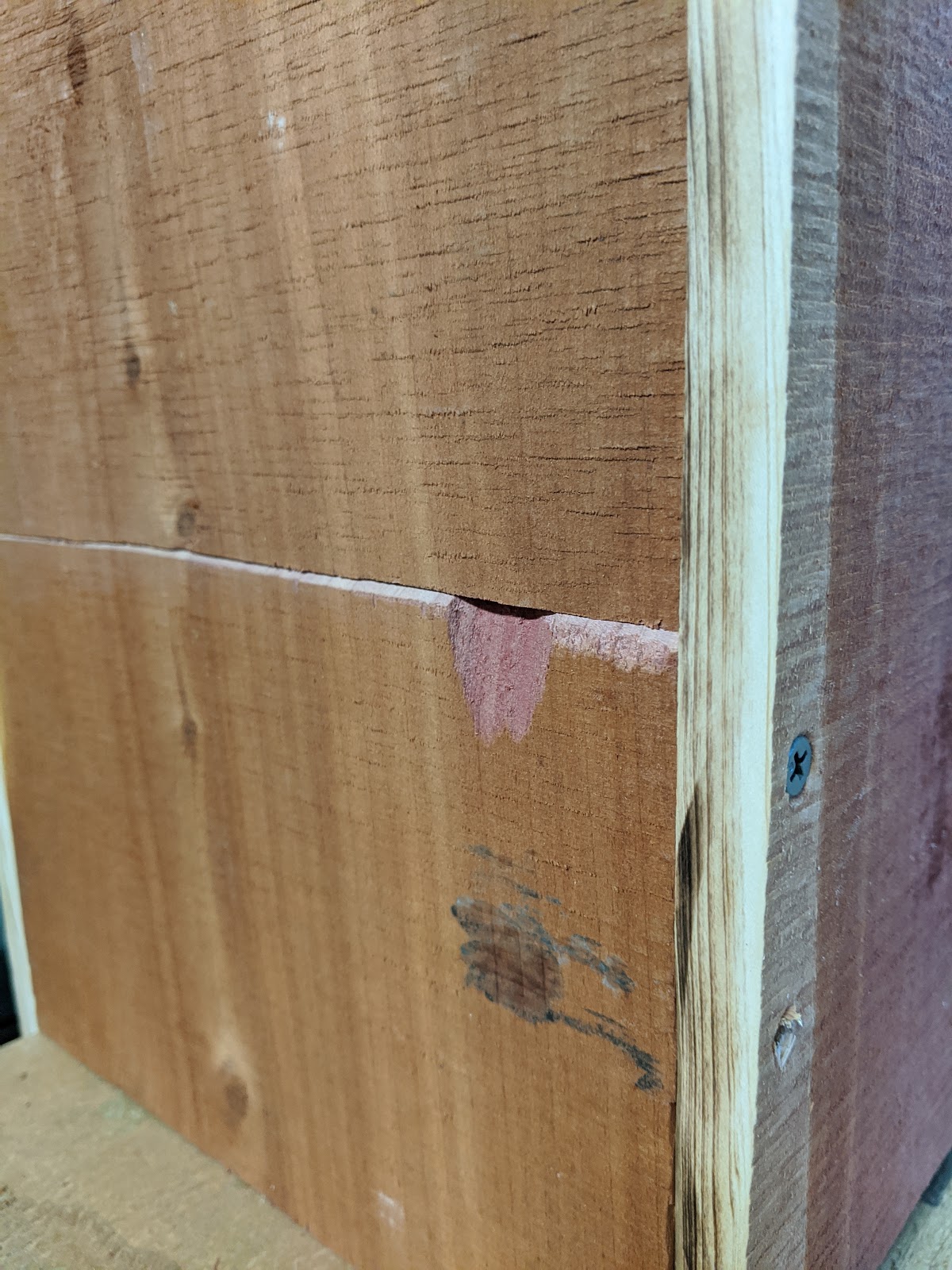
The clean-out access with the beveled edge.
A small cutout so you can lift the access door open. The dark scratches below are
from the chuck of the drill. I call that trial and error.
Not the prettiest duck house hole, but it will work. It's supposed to be 4 inches wide
by three inches high. It is...just a little lopsided.

Once I had the main structure put together I had to add the "ladder" for the ducklings. The plans called for 1/4" hardware cloth cut into a 4" x 12" strip and affixed inside, just below the hole. I made sure to trim the ends well to prevent injuries.

Just enough for their little wood duckling claws to grab hold of. Wood ducks have longer claws on
their webbed feet, specifically for climbing trees. 
The last piece of assembly was the roof. The plans called for it to be 11 1/4" x 13". I didn't have a board that wide, in either dimension. So I cut two boards that were 11 1/4" x 6 1/2" and glued/clamped them together overnight. The next day I smoothed out a bead of clear silicone caulk over the seam, inside and out and on the edges, to keep the moisture from softening the wood glue. The only thing left was to put it in place and screw it down.

The fully assembled Wood Duck House.

It's not bad for a first attempt with thin, scrappy boards. I must admit that I really love the color of the cedar boards. I know the wood will last virtually forever, but since it is so thin I hope it doesn't warp too badly in the weather. We'll see.

I had a 4" x 4" post and ordered a predator baffle from Amazon. Mounting it was a bit of a task. Neta and I picked out a spot that was away from where we usually walk around and offered enough cover and privacy for wood ducks to find it appealing. I filled the bottom about 4" deep with wood chips. I used a chainsaw to trim the bottom end of the post into somewhat of a point so I could pound it into the soft ground at the edge of the pond. I added the baffle to the post and carried all of my supplies (over several trips, including a step ladder and sledgehammer) over to the spot we picked out.

Once the post was in place I had a hard time balancing the house in one hand and maneuvering the drill/screw with the other so I could fasten it to the post, all while standing on the edge of the pond and trying to keep my feet dry (dry feet mission NOT accomplished). Some quick thinking had me using a large clamp to hold the house onto the post while I put in the top screw. With that done, I lined it up to make sure it was fairly straight (judging by the picture I may have to adjust) and added another screw to the bottom. DONE!

Getting this picture required wading over my boots around to
the other side of the pond. We've had a lot of rain.
So now that the house is in place it's probably a little late to catch the first brood of the season, but if any ducks decide they want to upgrade their living conditions, we'll be ready for them.

We'll keep you posted about any new tenants. Stay tuned!

Wednesday, December 25, 2019

Gimme Shelter

For those of you not familiar with life in the rural South, or at least around these parts of Georgia, your water comes from not just a well, but one with an exposed (to the weather) tank in the yard somewhere.


A brief history lesson on the well for this farm. 15 or so years ago, not long after Neta and I were married, we came down for a family visit. The first night I became very ill, from both ends to put it mildly. The next trip it happened again. I wasn't eating or drinking anything different than anyone else in the family. Why was I the only one getting sick?

After we left Neta's dad decided to have the water tested. If this was CSI, this would be a bloody fingerprint with the killer's DNA and a flashing neon sign saying "THE WATER DID IT!!!" The test came back showing the well water contained fecal coliform...because the well and the septic were separated by less than 50 feet. Did you know that you can build up an immunity to fecal coliform? I didn't. Neta's family was immune and my tender little tummy wasn't. Safe to say the well was soon moved across the yard.

Fast forward to the present. We had a couple of minor freezes the second year we lived here and had to thaw a couple of pipe joints with a hair dryer. Along with that, in the summer time our "cold" water is pretty warm coming from the tap because the tank is baking in the sun. We needed a pump house.

The basic frame with a slanted roof

Construction was scheduled for early 2019, but as you know we decided to get chickens/guineas and build a coop with the lumber we bought. Priorities! Finally this past November, a week before Thanksgiving, construction began.

All of the studs are in place on the sides.
The ends won't have any studs.

The main framing didn't take long, just a couple of days over two weekend's time. Once the framing was in place, it was only a couple of hours to put the siding on.

Both sides and the back end are covered.

I added basic rafters to the roof and crossed them with additional lumber to support the overhang of the roof. We needed roof material and as we always say around here, "the farm will provide". It did. We grabbed some metal roofing that was siding on our picnic shelter down by the big pond, cut it to size and screwed it in place.

It's pretty simple construction because if we ever have to have work done on the well, we need quick and easy access, both from the ends and the roof. The roof is screwed down just enough to hold it in a high wind, but can easily be removed. The ends are built to slide in/out from either side.


We're pretty happy to have this project marked off of our 2019 list. It will get painted and trim will be added once warmer weather comes back. We'll also install a hose bib to the outside so we can run the hose to plants/shrubs/trees that are further afield in the Goat Garden.

On to the next project...whatever that ends up being.

CHRISTMAS BONUS...

This morning I went out to the chicken coop to put some "decoy eggs" in the nesting boxes. This was to give the chickens a signal of where they should be nesting when the time comes. I placed two eggs in each of the two nesting boxes. As I turned around to leave...lo and behold...a Christmas miracle! There was a clutch of 9 light blue eggs in the opposite corner of the coop. I ran into the house and brought Neta out to show her. I should have taken a picture of them while still in the coop, but didn't. You'll have to settle for the "after" picture.

Our Easter Egger chickens have started...

A little early for Easter. It's our Christmas eggs!

Merry Christmas to all of our readers!!!

Friday, November 15, 2019

Odds & Ends - Catching Up

It has been a while. We'll let this entry serve as a catch-all of highlights since the end of July. Many pictures to follow.

If you want to jump around to the different subjects, you can click on any of the links below to take you further down the page:

Building Bigger Bridges
The Garden - Wrapping up Spring/Summer
Chicken and Guinea update
No More Facebook

A Home for Wayward Birds

A little over 5 weeks ago we acquired a baby quail chick. Not unsurprising since we live next door to a quail farm. It found its way into the chicken/guinea run. It was the tiniest chick we'd ever seen.  We did some reading and found out that quail mature around 5 weeks old. This one was only a few days at most. We quickly put together a brooder container (heat, food, water and some bedding material) that we kept in the coop and did what we could to raise it around the other birds for as long as we could.


Each day we'd "walk" it outside so it could get some fresh air, sunshine and socialize with the other birds so it wouldn't get lonely.


Sometime during the third week apparently a guinea or chicken must have knocked the top off the brooder and the chick escaped (they can fly at 2 weeks old). We discovered it walking around the yard with the guineas, like it was one of them. It escaped a couple more times during that week.

A slightly blurry picture of the quail around 3 weeks old.

By week 4 we were letting it out for a few hours, unsupervised and it stayed around the coop/run or followed the guineas. It seemed to be imprinted on the farm. The moment of truth happened last Sunday (Oct 27) when the chick walked up to me, looked up at me and promptly flew up and landed on my shoulder. WOW! I was so surprised. Sadly, it was our last day with the quail.


The next day, I walked out to discover the top off the brooder and the quail gone again. Normally no worries, but the guineas were gone too. They'd found their way down to the quail farm. When they saw me looking for them they ran to me and followed me home, but the quail wasn't in sight. No idea where it went. We'd like to think it heard the other quail and found a way to sneak into one of the quail houses and was adopted by a quail family. It was a fun adventure while it lasted.


Building Bigger Bridges


Last year around this time I rebuilt one of the bridges from the island to the "mainland". Another bridge, one that goes into the woods from the island was also in need of repair.

It was tilted and the right support (underneath) was rotted and breaking.
First I had to lift the old bridge and shore up the foundations on each side.

Lifting the far end of the old bridge to shore up the underneath foundations on each end.

The span was between 22 and 24 feet and my replacement pole was too heavy to lift and drag across. On top of that there was no way to get the tractor to the other side. I decided to leave the top boards in place as a "guide" while I pushed the new pole across the span with the tractor. It actually worked! Once I had it all the way across the span and the foundations shored up, I could disassemble the old bridge and remove the old (right side) support.

New support on the right side. The left support was still in good shape.
The middle pole was rotten about 2/3 of the way across.

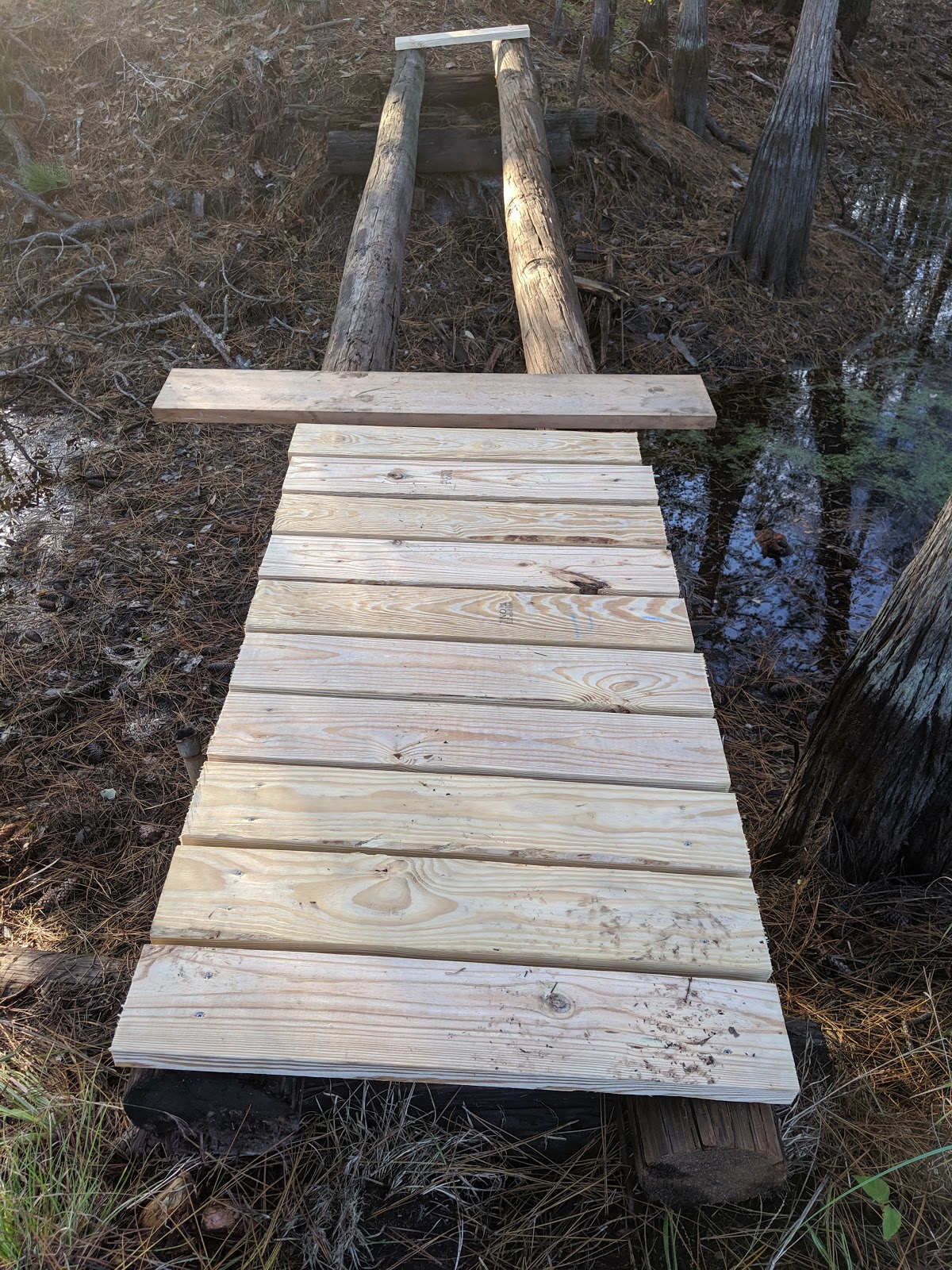
Once I had my left and right supports lined up, it was time to add the new treads.

Making progress...


Complete...and solid! Third and final bridge in the background.
Two bridges down and one to go. That will be another blog entry...someday.


The Garden - Wrapping up Spring/Summer

I'll make this brief:

Spring peas - Good crop. Delicious right off the vine
Tomatoes - Too much early rain, they didn't do well
Squash - Started well, tapered off quick
(Japanese) Sakata melons -  Did well
Watermelons - Also did fairly well. Finally had success with our heirloom Bradfords
Cantaloupe - Good crop
Cucumbers - Good crop early, then tapered
Jalapenos - Tons early, rains killed them later
Eggplant - 5 or more varieties, still growing and producing like gangbusters

One of our Bradford watermelons
A couple of our Sakata melons. They were sweet and you could eat them right up to
and including the rind.


A bucket of cukes.
We grew at least 5 varieties. All successful.

We grew a variety of squash called the "Seminole Pumpkin" which is similar to a butternut squash. We not only had a good crop, we had a varied crop as some of them grew like butternut squash with long necks and others grew like small pumpkins.


We have an "orange" crop this year. We grow three varieties of Satsumas, which are similar to Mandarins or Halos. Three of our trees produced fruit this year.

This is the St. Ann variety. It produced the larger of our Satsumas.

This is our Owari variety. It produced a very juicy and sweet Satsuma.


We're also growing some "exotic" or experimental produce...

We're harvesting Roselle (aka Florida cranberry). It's used to make Hibiscus Tea and also  "Florida Cranberry Sauce". It tastes remarkably similar to cranberry and it's a very pretty plant to grow as it's in the Hibiscus family.


These are the calyx (bud) of the plant that open to reveal the flower and seed pods.
This is about 10% of the buds that covered the flower stalks.

Fingers-crossed on this one, Passionfruit (yellow and purple). So far we've found 4 fruit on our massive vines. They're about the size of a tennis ball at the moment. The vine is blooming like crazy. We're going to try to protect it enough to harvest the fruit if we can, then cut it back, dig it up and put it in a pot in the greenhouse for the winter.


Chicken and Guinea update

The last time you saw our chickens they were much younger and we were still figuring who was who (and what). Well...we traded 5 of them back to the breeder as 6 of the 8 birds she gave us were roosters. We kept one rooster (a Lavender Orpington). We got 2 new Lavenders (hens) and 3 new Easter Eggers. Now our chicken yard looks like it should. One rooster and the rest hens.

Our guineas have grown quite a bit and their colors are very apparent now. They roam all over the farm and frequently come to the house squawking for sunflower seed treats. The chickens don't roam as far, but they all free range around the farm.

We lost a guinea a few weeks back. They wouldn't go into the coop one evening because a cat had inadvertently wandered in, then back out. The guineas scattered that night with several sleeping in the trees and the majority of them sleeping on the roof of the barn. The next morning we were missing one. Such is life with guineas.

All 8 of the chickens

Our rooster, proudly crowing

The guineas out on a rainy day

No More Facebook

If you're looking for blog updates, you won't find us on Facebook anymore. Neta and I decided to drop Facebook for a number of reasons. We're sorry for any inconvenience. We hope you'll stick with us.

If you want to stay up to date with our blog, click this link -> Subscribe to The Hagan Farm by Email. We promise you'll only get our posts, no SPAM.

Lulu says, "SUBSCRIBE!!!"